
How to Get a Pancake Stretch
The seated straddle fold looks like a party trick. It's really three separate mobility problems stacked on top of each other — here's how to train each one, and why holding the stretch longer isn't the answer.
9 min read · Updated July 2026
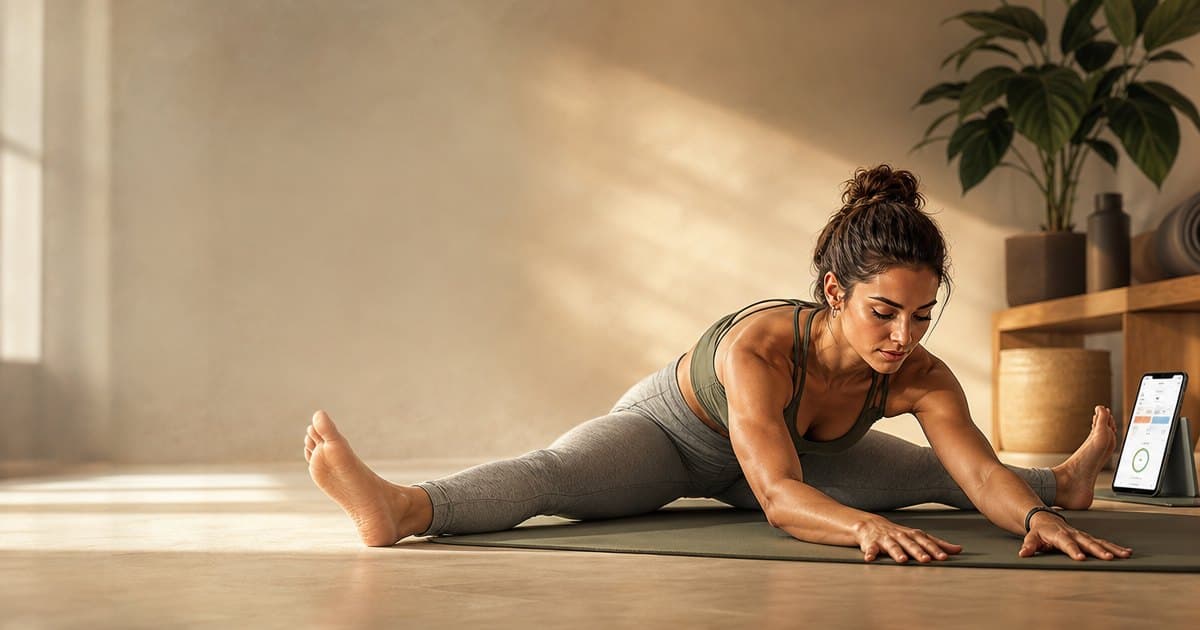
What the pancake actually demands
The pancake stretch — sitting with your legs in a wide V and lowering your chest and forehead to the floor — looks like a single flexibility feat. It isn't. It's three separate mobility requirements stacked on top of each other, and if any one of them is the limiter, adding more of the other two does nothing.
To lie flat in a wide straddle you need:
- Hamstring length, so the pelvis can tip forward over the legs instead of tucking under.
- Adductor (inner-thigh) length, so the legs can spread wide without pulling the pelvis into a backward tilt.
- Hip flexion and external rotation, so the hip joints let the femurs settle open and the torso can hinge deep into the crease.
That's why generic "just stretch more" advice stalls people. The person stuck at 30 degrees off the floor usually doesn't have a single tight muscle — they have one gate that's locked while they keep hammering the two that are already open. The fix is to train all three, on different days, and to notice which one talks back first.
Why holding stretches longer stops working
Most people train flexibility the same way: sink into the deepest stretch they can tolerate, hold it, and wait. That works — for a while. Then it stops, and holding for two minutes instead of one changes nothing. Here's why.
A passive hold mostly teaches your nervous system to tolerate a position. It raises your "stretch tolerance," but it does little to build control at the new length. So you gain a range you can only access when you're warm, relaxed, and pulling yourself into it — and you lose it the moment you need the muscles to actually work there. That's the plateau: a range you can flop into but not own.
The way through is active and loaded end-range work:
- End-range strength — good mornings and leg lifts that make the muscles contract in the stretched position, so your body trusts the range and stops guarding it.
- PNF (contract–relax) — at your first honest stop, press the legs down into the floor for five or six seconds, then release and fold deeper. This "fools" the stretch reflex and reliably unlocks new range on the spot — the gain is temporary at first, but repeating it week to week makes the range stick.
- Isometrics at width — holding a strong wide position (a horse stance, a straddle hover) builds the active control that turns a passive range into a usable one.
This is the whole logic of the two-routine progression below: earn the passive range first, then make it permanent by getting strong in it.
The progression, week by week
RepDriver ships two free guided routines built around exactly this. Start with Pancake Path to open the three gates passively, then graduate to Pancake Power to build the active, loaded, and PNF work that makes the range stick. Both run on an every-other-day cadence — the deep work needs a recovery day.
| Routine | Structure | What it trains | Session |
|---|---|---|---|
| Pancake Path | 12 sessions across 3 phases (Gentle Start → Open Up → Power Prep), every other day | Hamstrings · Adductors · Hip mobility · Pancake practice — a beginner-friendly passive foundation, one gate per day, progressively deeper each phase | ~10–22 min |
| Pancake Power | 12 sessions across 3 phases (Foundation → Build → Peak) | Adds active good mornings, straddle leg lifts & hovers, an isometric horse stance, and a PNF contract-relax drill — the overload the passive plan lacks | 30+ min |
Pancake Path is built for beginners and cycles through four focus days so each gate gets dedicated attention without frying you: Hamstring Foundation (forward folds and half-pancake), Adductor & Inner Thigh (butterfly, frog, straddle prep), Hip Mobility (pigeon, figure-four, low lunge), and Pancake Practice, where you warm everything up and then spend honest time in the straddle. Its three phases grow from ten easy minutes of supported stretching to twenty-plus minute sessions, ending with light previews of Power's active drills. Four or five weeks of this and the passive fold noticeably deepens.
Pancake Power is the strength counterpart. It keeps the deep stretches but stacks the three overload tools on top, and each of its three phases raises the active work, the PNF rounds, and the goal-hold depth — so it's genuinely progressive rather than the same session on repeat. This is where a range you can flop into becomes a range you own.
Follow it in the app
Pancake Path — the beginner foundation
Twelve progressive sessions that open the hamstrings, adductors, and hips one gate at a time, growing from ten gentle minutes to your first real pancake holds. Start here. Try any day free in your browser — voice-guided, with music and a calm background.
Try any day free — no signupFollow it in the app
Pancake Power — the active progression
Twelve sessions across three phases that add good mornings, leg lifts, hovers, a horse-stance isometric, and a PNF drill to make your new range permanent. Graduate here once Path feels easy.
Try any day free — no signupThe moves that matter
A handful of movements do most of the work. Tap any one to see it demonstrated with per-step voice guidance on its own page.
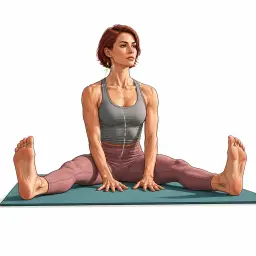
Seated Straddle Prep
The honest pancake prep — wide V, knees up, walk the hands forward with a long spine. Your everyday baseline.
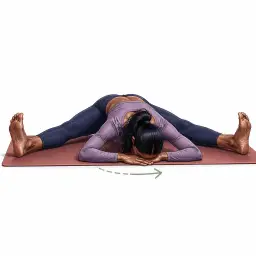
Full Pancake
Hinge from the hips and melt the chest, then forehead, toward the floor over many breaths. The goal position.
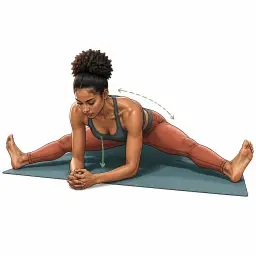
Pancake PNF (Contract–Relax)
Press the legs into the floor for five or six seconds, release, and fold deeper. Unlocks new range fast.
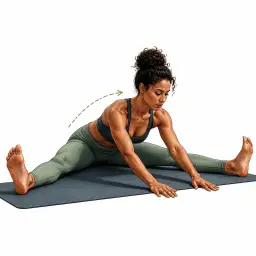
Seated Straddle Good Morning
Flat-back hinge forward and back for reps — builds strength inside the stretch so the range holds.
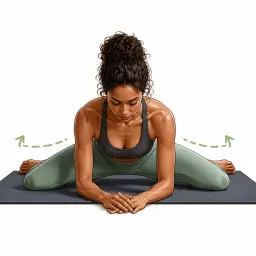
Frog Pose
Knees wide, hips dropping back — the deepest direct adductor opener, the second gate to a pancake.
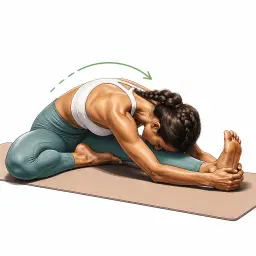
Half Pancake
One leg long, fold over it — isolates each hamstring so a tighter side can't hide behind the other.
Five mistakes that stall you
- Rounding the back to fake depth. Chest-to-floor from a rounded spine isn't a pancake — it's a lumbar flexion you'll pay for. Hinge from the hip crease with a flat back, even if that means stopping higher.
- Only ever holding. Passive holds raise tolerance but not control. Without the active and PNF work, you cap out at a range you can't use. This is the single biggest reason people plateau.
- Training the open gates. If your hamstrings are the limit, more adductor stretching won't move your pancake. Find the first thing that says stop, and train that.
- Letting the feet flop. Point the toes and the legs roll, cheating the stretch and stressing the knees. Keep the feet flexed and the kneecaps pointing up.
- Grinding the loaded work daily. Gentle mobility can be daily — but the loaded end-range work (PNF holds, weighted straddle) trains like strength, so give those sessions a day between. Three to four loaded sessions a week is the sweet spot.
Common questions
- How long does it take to get a full pancake stretch?
- For most adults training consistently 3–4 times a week, a noticeable change in depth comes in 4–8 weeks, and a chest-to-floor pancake typically takes several months to a year depending on your starting range, hip structure, and how patiently you build end-range strength. Bone shape (hip socket depth and orientation) sets a hard ceiling for a minority of people — but almost everyone can get dramatically closer than they are now.
- Is the pancake stretch bad for your back?
- No, when you hinge from the hips with a long spine. The pain and risk come from rounding the lower back to chase depth — that loads the lumbar discs in flexion instead of stretching the hamstrings and adductors you're actually targeting. If you can only reach the floor by rounding, you've gone past your honest range; back off until the fold comes from the hip crease with a flat back.
- What's the difference between a pancake and a middle split?
- A pancake is a seated fold — legs wide, torso lowering forward toward the floor. A middle split (side split) is standing or lying with the legs spread sideways until the inner thighs reach the ground. They share the adductor and hamstring demand, so pancake training carries over to the middle split, but the pancake also loads a forward hip hinge that the middle split doesn't.
- How often should I train the pancake stretch?
- Gentle mobility can be done often — even daily. It's the loaded end-range work (PNF holds, weighted straddle) that trains like strength, so give those sessions a day between to recover. Three to four loaded sessions a week is the sweet spot: flexibility gains come from frequent exposure, while the harder overload work needs recovery. Both RepDriver pancake routines default to an every-other-day cadence to pace that loaded work.
- Can I get a pancake if I'm not naturally flexible?
- Yes. 'Naturally flexible' people start closer to the finish line, but the mechanism of improvement — building strength and control at the end of your current range — is the same for everyone. Stiffer people often make faster early progress precisely because they have more range to reclaim.
- Do I need to warm up before pancake stretching?
- Yes. Cold deep stretching is where most tweaks happen. A few minutes of hip circles, cat-cow, and a couple of dynamic straddle reaches raises tissue temperature and primes the nervous system so your end range is both deeper and safer. Both routines open every session with a built-in warm-up.
Sources & further reading
The claims in this guide are backed by peer-reviewed research and public-health and professional bodies. Follow any link to read the primary source.
- 1.Static stretching produces real range-of-motion gains over about six weeks — Physical Therapy (1997)
- 2.Hip socket shape sets a bony ceiling on hip range of motion for some people — Clinical Orthopaedics and Related Research (2018)
- 3.Stretching frequency is positively associated with flexibility gains — Int. Journal of Sports Medicine (2018), review
- 4.Warm up before deep stretching — cold muscle is easier to strain — Harvard Health Publishing
- 5.Flexibility gains are largely increased stretch tolerance, not permanently longer muscle — Physical Therapy (2010)
- 6.Strength training builds range of motion about as well as stretching — Healthcare (2021), meta-analysis
- 7.PNF (contract–relax) stretching reliably increases range of motion — Journal of Human Kinetics (2012), review
Put it on your real calendar.
Create a free account to schedule the routine, follow along with voice guidance and music, and log every session — or just browse the library first.
Create a free account