
Yoga for People Who Lift
Lifting builds strength and, quietly, stiffness — in a handful of predictable places. A generic flow class won't find them. This is what to mobilize, why, and when.
8 min read · Updated July 2026

Why lifters get stiff — and where
Lifting doesn't make you inflexible everywhere. It stiffens a specific, predictable set of links — and if you sit at a desk the rest of the day, the same ones get hit twice. Knowing where the tightness actually lives is what makes mobility work efficient instead of a vague "do some stretching."
The usual suspects:
- Hip flexors and quads — squatting loads them, and sitting keeps them short. Tight hip flexors tug the pelvis and can flatten your squat and nag your lower back.
- Thoracic spine and chest — benching, pressing, and desk slump all pull you into rounding. A stiff upper back robs you of a clean overhead position and a tall squat.
- Hamstrings and glutes — deadlifts and heavy hinging leave the back chain tight and cranky the next morning.
- Wrists, forearms, and shoulders — gripping heavy bars and pressing overhead beats up the small joints that rarely get any maintenance.
Target those, and you've covered most of what lifting tightens. Ignore them and you drift toward the positions that cause tweaks.
Why a generic flow class misses
A typical vinyasa class is built to flow — to keep moving, chase novelty, and give a full-body sweat. That's a fine workout, but it's the wrong tool for a lifter's stiffness, for two reasons.
- It moves too fast to change tight tissue. Restricted hip flexors and hamstrings respond to held positions — at least 30 seconds of honest tension — not a two-breath pass on the way to the next pose.
- It isn't aimed at your links. A general class spends as much time on things you're already fine at as on the four areas that actually limit you. You get a workout; you don't get targeted change.
A lifter-focused routine flips both: long, held stretches, aimed squarely at the hips, T-spine, hamstrings, and wrists lifting leaves behind. Less flow, more fix.
The six-day reset
RepDriver's free Lifter's Reset is a six-day rotation of held-pose mobility, each day aimed at a different link. Run it as active recovery — one day whenever you need it, or rotate through the week on off-days. It rests every seventh day and repeats.
| Day | Focus | Best after |
|---|---|---|
| 1 · Hip Flexor Decompress | Front of the hips, quads, a passive twist | Squat day or a long sit |
| 2 · T-Spine & Chest Opener | Upper-back extension, shoulders, chest | Bench / press day or desk slump |
| 3 · Hamstring & Glute Release | The whole back chain, long holds | Deadlift or leg day |
| 4 · Full-Body Mobility | A bit of everything — the do-this-one day | Any day you only have one in you |
| 5 · Shoulder & Wrist Reset | Grip, forearms, shoulders | Heavy pressing or pulling |
| 6 · Restorative | Passive, long, calming holds | Before bed / a true rest day |
Follow it in the app
Lifter's Reset — six days of targeted mobility
Held-pose flows for the exact links lifting tightens, voice-guided with calm music. Try any day free in your browser — no signup.
Try any day free — no signupThe moves that matter
These do the heavy lifting for a lifter's tight spots. Tap any one for a step-by-step demo with voice guidance.
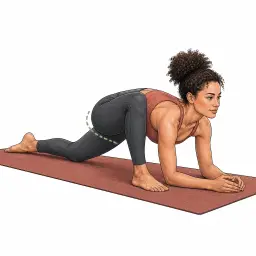
Lizard Pose
A deep low lunge into the front of the hip and groin — the antidote to squatting and sitting.
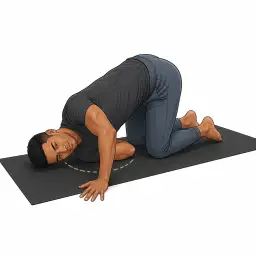
Thread the Needle
Rotates and opens the thoracic spine and rear shoulder — undoes pressing and desk rounding.
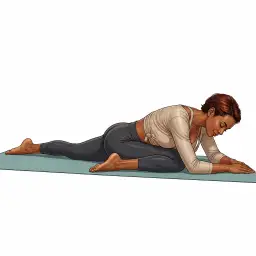
Pigeon Pose
The classic deep glute and outer-hip opener for tight, cranky hips after heavy lower work.
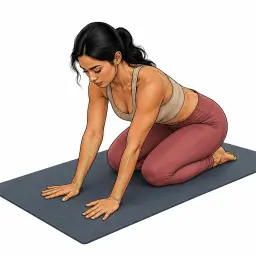
Seated Wrist Release
Maintenance for the wrists and forearms that grip every heavy bar — gold if you also type all day.
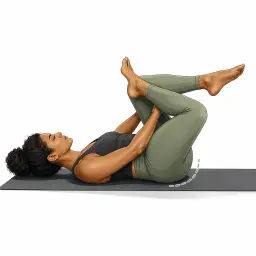
Supine Figure-Four
A gentle reclined glute and piriformis release — easy on the back, deep on the outer hip.
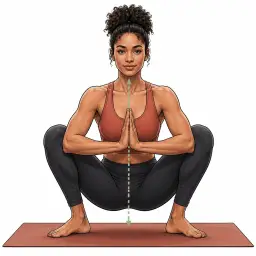
Garland Pose
A deep supported squat that opens the hips, groin, and ankles — straight carryover to squat depth.
When to use it
- On rest / off days — the best slot. You improve range and circulation without touching your lifting performance.
- After a session — a good time for deep stretching: the tissue's warm and there's no lift left to protect, so you can safely push range.
- Not right before heavy lifting. Long static holds minutes before a max effort can briefly reduce output — keep the pre-lift warm-up dynamic and save the deep work for after.
- Before bed — the restorative day is built to down-regulate; it doubles as a wind-down.
Common questions
- Should lifters do yoga?
- For mobility and recovery, yes — but targeted mobility, not necessarily a full yoga practice. Lifting shortens and stiffens a predictable set of tissues (hip flexors, thoracic spine, hamstrings, wrists), and holding stretches that open exactly those areas improves your positions under the bar — and rest days are a natural time to train that range. You don't need to become a yogi; you need to un-stiffen the specific links lifting tightens.
- Will yoga make me less strong?
- No. The old worry that stretching 'makes you weak' comes from studies on long static stretching immediately before a max lift — which can briefly dull power. Doing mobility work on rest days or after training has no such effect and, by improving your range, often lets you hit better positions (a deeper squat, a stable overhead) that build more strength. Timing is everything: keep deep stretching away from the minutes right before heavy lifting.
- Should I do yoga on rest days or training days?
- Rest days and post-session are ideal — that's when you can train range without interfering with performance and there's no heavy lift to protect. If you want mobility on a training day, do it after your lifts, or do only light dynamic movement beforehand. The Lifter's Reset routine is built as a rest-day / active-recovery flow for exactly this reason.
- Does yoga help squat depth and overhead position?
- It can, when it targets the actual restriction. Ankle, hip, and adductor mobility gate squat depth; thoracic-spine extension and shoulder mobility gate a clean overhead position. The poses in a lifter-focused routine are chosen to open those specific links, which is why it carries over to the bar in a way a random flow often doesn't.
- How often should a lifter do mobility work?
- Two to four short sessions a week covers most people — enough frequency to change tissue and maintain range without eating into training. Consistency matters more than length; fifteen focused minutes several times a week beats one long occasional session.
- Do I need to be flexible to start?
- No — stiff lifters are exactly who this is for, and they often make the fastest early progress because they have the most range to reclaim. Every pose scales: you go to your own honest edge, not a picture in a magazine.
Sources & further reading
The claims in this guide are backed by peer-reviewed research and public-health and professional bodies. Follow any link to read the primary source.
- 1.Long static stretching right before a max effort can briefly reduce strength and power — Scand. J. Medicine & Science in Sports (2013), meta-analysis
- 2.Ankle dorsiflexion mobility is associated with how deep you can squat — Sports Biomechanics (2020)
- 3.Stretching frequency is positively associated with flexibility gains — Int. Journal of Sports Medicine (2018), review
- 4.A 30-second static stretch improves flexibility as much as longer holds — Physical Therapy (1997)
- 5.Stretching before or after exercise does not meaningfully reduce muscle soreness — Cochrane Database of Systematic Reviews (2011)
- 6.Yoga: what the evidence shows — U.S. NIH — National Center for Complementary and Integrative Health
Put it on your real calendar.
Create a free account to schedule the routine, follow along with voice guidance and music, and log every session — or just browse the library first.
Create a free account