
The Dumbbell-Only PPL Program
Push/pull/legs is the most-run split in lifting for a reason — and it doesn't need a barbell, a rack, or even a bench. Here's the complete dumbbell version, with the progression rules that make it work at home.
9 min read · Updated August 2026
Why push/pull/legs works
Push/pull/legs is probably the most-run training split in the world, and its logic is simple: group the muscles that work together, so nothing gets trained while it's still recovering from yesterday. Push day is chest, shoulders, and triceps — everything that presses. Pull day is back and biceps — everything that rows. Legs day is squats, hinges, and calves. Run the three days twice and every muscle gets the twice-a-week frequency that beats once-a-week for growth, with two full days between repeats of the same pattern.
None of that logic mentions a barbell. The split is organized around movement patterns, and dumbbells cover all of them — pressing, rowing, squatting, hinging, and every isolation move that matters. The tissue doesn't know what's loading it; it knows hard sets and progression. What kills dumbbell PPL attempts isn't the equipment — it's downloading a static PDF, guessing at weights, and losing track by week two.
The no-bench problem (and the floor press)
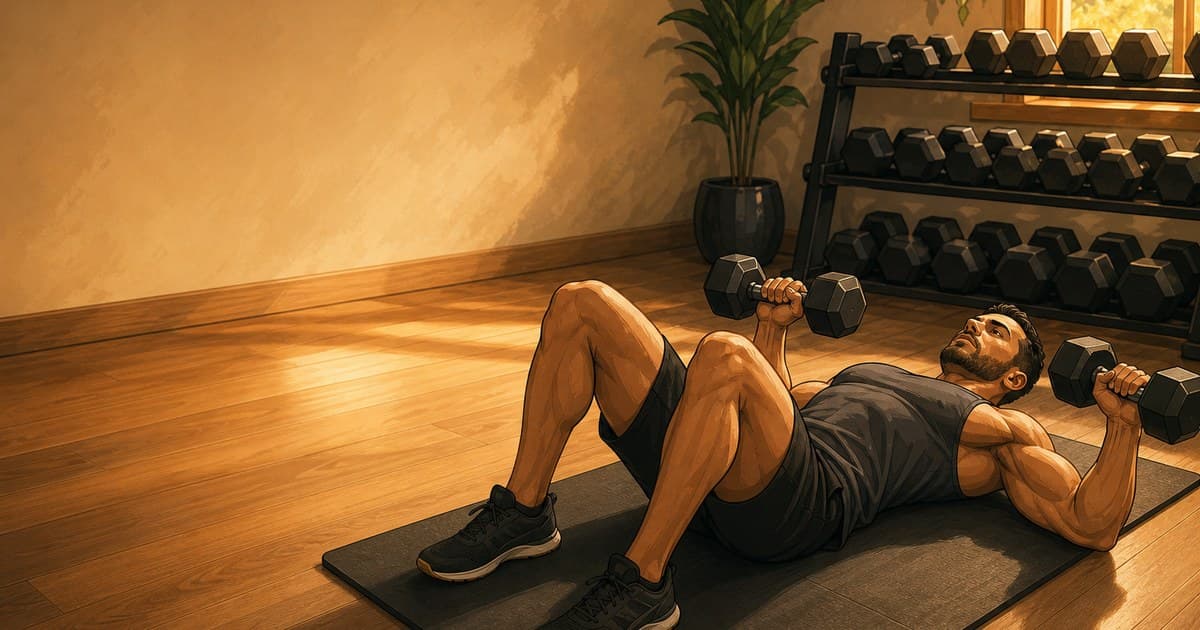
The standard objection to home PPL is the bench: every classic push day is built around bench pressing. The fix is older than the bench itself — the dumbbell floor press. Lie on the floor, knees bent, and press the dumbbells from where your upper arms rest on the ground. The floor caps the range of motion at the point most shoulders prefer, you can press heavy with zero spotter risk, and the strength carries straight over to benching when you eventually get one.
Everything else adapts just as cleanly: one-arm rows brace on a chair instead of a bench, split squats elevate the rear foot on the sofa, and overhead pressing works seated on any sturdy chair with a tall back. This program prescribes those versions directly — there is no exercise in it that needs anything beyond dumbbells, a chair, and floor space.
The 6-day week (and the 3-day version)
The classic PPL week is six sessions and a rest day. Each pattern appears twice as an A and a B session — same muscles, different emphasis, so the week stays interesting and every region gets hit from two angles:
| Day | Session | Anchor lifts |
|---|---|---|
| Mon | Push A — chest-led | Floor press, shoulder press, lateral raises |
| Tue | Pull A — row-led | Two-dumbbell row, one-arm row, curls |
| Wed | Legs A — squat-led | Goblet squat, Romanian deadlift, lunges |
| Thu | Push B — shoulder-led | Shoulder press, floor press, thrusters |
| Fri | Pull B — hinge-led | Dumbbell deadlift, one-arm row, rear delts |
| Sat | Legs B — single-leg-led | Bulgarian split squat, good mornings, swings |
| Sun | — rest — |
Can't train six days? Don't change the program — change the calendar. Run the same six sessions in order at three or four days a week (Push, Pull, Legs, rest, repeat), and the cycle just takes longer than a calendar week. In RepDriver you can drag any scheduled session to a new date and cascade everything after it, so the 3-day version is the same enrollment with more space between workouts.
The program
RepDriver's free Dumbbell PPL is the complete eight-week version of this split, guided end to end by the timed runner: pattern-matched warm-ups, work and rest timers, and per-set weights auto-scaled to the dumbbells you own. Presses and rows pyramid in the 6–10 range; isolation runs 10–15 — both ranges grow muscle equally well when sets end close to failure.
Follow it in the app
Dumbbell PPL — 6-day push/pull/legs split
Eight weeks of guided push/pull/legs with dumbbells only — no bench, no bar, no guesswork. Try any day free in your browser, no signup.
Try any day free — no signupThe moves that matter
Six lifts anchor the split. Tap any one for the step-by-step form page.
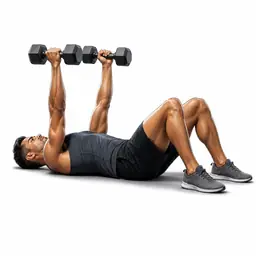
Dumbbell Floor Press
The no-bench horizontal push — the floor caps the range right where your shoulders want it.
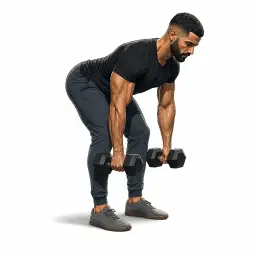
Two-Dumbbell Bent-Over Row
Pull day's anchor. Flat back, elbows driving behind you, no momentum.
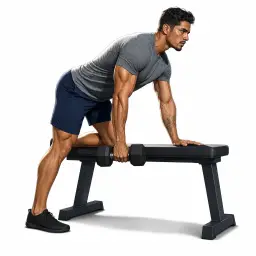
One-Arm Dumbbell Row
Braced on a chair, one side at a time — a stronger side can't quietly carry a weaker one.
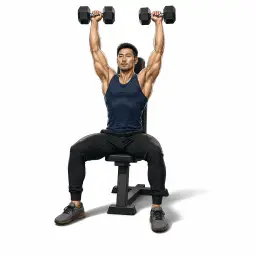
Dumbbell Shoulder Press
The vertical push, with a friendlier path for the shoulders than a bar.
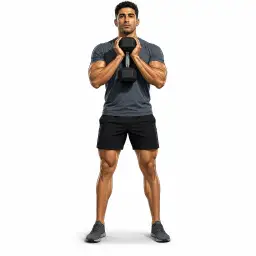
Goblet Squat
The most coachable squat there is — the weight itself keeps you upright.
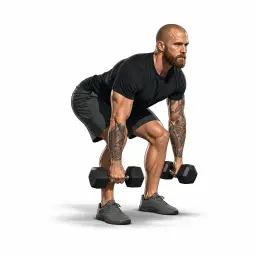
Dumbbell Deadlift
Pull day's hinge, in the classic PPL deadlift slot. The heaviest lift of the week.
Progressing when your dumbbells jump in 5 lb steps
This is the question every dumbbell PPL thread eventually asks: a barbell progresses in 2.5 lb increments, but a dumbbell jump is 5 lb per hand — a 10-pound jump on a two-dumbbell lift, often 15–20% on isolation moves. Straight linear progression stalls fast. The answer is double progression: progress reps inside a range first, and only then take the jump.
- Own the range. Each lift has a rep range (say 8–12). Keep the weight fixed and add reps week to week until you hit the top of the range on every set.
- Then jump and rebuild. Move up 5 lb per hand, drop back to the bottom of the range, and climb again. The rep climb bridges the gap the plates can't.
- When the jump is still too big — common on lateral raises and curls — slow the lowering phase to three seconds, add a one-second pause at the stretch, or shave the rest period. Each makes the same weight meaningfully harder.
Two rules keep the whole engine honest. Sets should end one to three reps short of failure — close enough to grow, controlled enough to recover across six sessions. And the numbers have to be written down: progression that isn't tracked quietly stops happening, which is why the runner logs every set, remembers your per-exercise weight adjustments, and re-prescribes them next time that lift appears.
Prefer fewer, longer sessions instead of six short ones? The 4-day dumbbell upper/lower plan trains the same muscles on a 2-on/1-off rhythm — same principles, different calendar.
Common questions
- Can you really do PPL with only dumbbells?
- Yes — the split is defined by movement patterns, not equipment. Push day is horizontal and vertical pressing plus triceps; pull day is rows, a hinge, and biceps; legs day is squats, hinges, and calves. Dumbbells cover every one of those patterns, and the research is consistent that muscle responds to hard, progressively heavier work regardless of what's loading it. The only real casualties are barbell-specific lifts like heavy back squats — and single-leg work like Bulgarian split squats closes most of that gap.
- Do I need a bench for a dumbbell PPL?
- No. The floor press replaces the bench press as the horizontal push — the floor caps the range of motion at the point most people's shoulders prefer anyway, and it lets you press heavy with no spotter. Wherever a session braces on a bench (one-arm rows, split squats, seated pressing), a sturdy chair or the arm of a sofa does the same job. A bench is a nice upgrade later, not an entry requirement.
- Is a 6-day PPL too much for a beginner?
- Usually, yes — six lifting days is a schedule commitment more than a recovery problem at beginner loads, but missing days is what actually kills PPL runs. The fix isn't a different program: run the same six sessions in order at three or four days per week instead, so the cycle simply takes longer than a calendar week. Push/Pull/Legs, rest, repeat is the classic 3-on-1-off version and it preserves everything that makes the split work.
- How heavy should my dumbbells be for PPL?
- Adjustables reaching 50–70 lb per hand cover most lifters for a long time; this program's heaviest prescription is an 80 lb top set on the dumbbell deadlift. Granularity matters more than the ceiling — roughly 5 lb steps are what make week-to-week progression possible. RepDriver also auto-scales every prescribed weight to the heaviest dumbbell you actually own, so the program meets your set where it is.
- How long does a PPL workout take?
- These sessions run about 35–45 minutes including the warm-up: five exercises of three to four sets, with rests of 45–120 seconds matched to the lift. The timed runner enforces the rests, which is where most home sessions quietly bloat — a strict 45-minute session with honest rest periods out-trains a drifting 90-minute one.
- What results should I expect, and by when?
- Strength moves first: expect visible rep and load increases inside the first month, largely from your nervous system learning the movements. Noticeable muscle change typically arrives around weeks 8–12 given adequate protein — about 1.6 grams per kilogram of bodyweight per day — and sleep. That's why the program runs in 8-week cycles: long enough for real change, short enough to stay honest.
Sources & further reading
The claims in this guide are backed by peer-reviewed research and public-health and professional bodies. Follow any link to read the primary source.
- 1.Training each muscle about twice a week beats once for growth — Sports Medicine (2016), meta-analysis
- 2.Lighter sets taken close to failure build as much muscle as heavy ones — J. Strength & Conditioning Research (2017), meta-analysis
- 3.Stopping 1–3 reps short of failure carries no meaningful growth penalty — Journal of Sport and Health Science (2022), meta-analysis
- 4.Free weights and machines produce equal muscle growth — BMC Sports Science, Medicine & Rehabilitation (2023), meta-analysis
- 5.About 1.6 g of protein per kg of bodyweight maximizes training gains — British Journal of Sports Medicine (2018), meta-analysis
Put it on your real calendar.
Create a free account to schedule the routine, follow along with voice guidance and music, and log every session — or just browse the library first.
Create a free account