
How (and When) to Deload
The muscle you stimulate in training is built during recovery — and every hard block quietly accumulates fatigue that training through doesn't fix. The deload is where the gains get collected.
7 min read · Updated July 2026

What a deload actually is
Training doesn't build muscle — training creates the stimulus, and recovery builds the muscle. Most weeks, sleep and food cover the recovery bill. But hard training also accumulates a slower kind of fatigue — connective tissue stress, nervous-system wear, the general grind — that a normal rest day never fully clears. Stack enough weeks and it starts masking your fitness: lifts stall, sessions feel heavy, and pushing harder digs the hole deeper.
A deload is the scheduled fix: one deliberately easy week — about half your usual sets at loads light enough to feel almost silly — that lets the accumulated fatigue drain while you keep the habit and the movement patterns. Fatigue clears faster than fitness fades, which is why you come back fresh — fatigue cleared, nothing lost — ready to push again. The evidence is that you hold your strength and shed fatigue — not that the easy week itself makes you stronger.
The signs you need one
Planned beats reactive — every 4–8 hard weeks is the standard rhythm. But if you train by feel, these are the invoices arriving:
- Stalled or regressing lifts across several sessions, not one bad day.
- Worse sleep while more tired — the classic overreach tell.
- General joint achiness — elbows, knees, shoulders complaining without a specific injury.
- Dread — when the pre-workout feeling shifts from appetite to obligation.
Any two together: deload now, not after one more hard week.
How to deload properly
| Knob | Normal week | Deload week |
|---|---|---|
| Sets per exercise | 3–4 | 2 |
| Load | Your working weights | ~60% of them — deliberately easy |
| Effort | 1–3 reps from failure | Nowhere near failure. Every rep smooth |
| Rest | As programmed | Longer — no rushing |
| Extras | — | Held stretching, walks, sleep like it's your job |
The hard part isn't the prescription — it's the discipline to keep it easy. If a deload set feels like training, it's too heavy. You should leave every session feeling better than you arrived, and by day five, restless. Restless is the signal the tank is refilling.
The ready-made week
RepDriver's free Deload Week packages this so you can't accidentally overdo it: three light full-body dumbbell sessions on alternating days — two easy sets per movement at deliberately light prescriptions, long rests — each closing with a few minutes of voice-guided held stretching, ending in a proper rest pose. It runs exactly once (a deload is a week, not a lifestyle) and slots cleanly between blocks of the Mass Builder or any hard program.
Follow it in the app
Deload Week — one light week between blocks
Three easy full-body sessions with built-in stretch cooldowns. Half volume, light loads, zero heroics. Try it free — no signup.
Try the deload freeA taste of the week's vocabulary — light, familiar, and ending calm:

Goblet Squat
The week's squat — at loads that feel like a warm-up, because that's the point.

Dumbbell Romanian Deadlift
Keeps the hinge pattern greased without taxing the lower back.
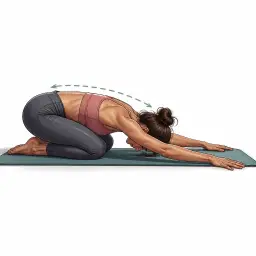
Child's Pose
Opens each cooldown — let the week's tension drain.

Seated Forward Fold
A long, patient hamstring stretch to close the session.
The classic deload mistakes
- Accidentally training hard. You feel fresh by Wednesday and the weights feel light, so you push. Congratulations — you skipped your deload. Fresh-feeling is the process working, not an invitation.
- Deloading only when broken. Reactive deloads work, but they arrive after weeks of stalled progress you could have kept.
- Turning it into a couch week by default. Occasionally fine, but light movement recovers you faster than none, and the habit survives.
- Dieting hardest during it. Recovery is the point; a deep deficit fights it. Eat at least at maintenance this week if you can.
- Skipping it forever because nothing hurts yet. The invoice always arrives — scheduled deloads just let you pick the delivery date.
Common questions
- What is a deload week?
- A planned week of deliberately easy training — typically about half your normal sets at roughly 60% of your normal loads — inserted between hard training blocks. You keep moving and keep the habit, but drop the stress low enough that accumulated fatigue clears. It's not a week off; it's a week of easy practice that lets the previous weeks' work turn into actual adaptation.
- How often should I deload?
- Every 4–8 weeks of hard training is the standard rhythm for most intermediate lifters, and it's why RepDriver's Mass Builder runs 8-week cycles. Newer lifters generating less fatigue can often go longer; older lifters, very heavy programs, or training deep in a calorie deficit usually warrant closer to every 5–6 weeks. Planned beats reactive — by the time your body demands one, you've usually left progress on the table.
- Will I lose muscle during a deload week?
- No. Detraining takes multiple weeks of doing nothing — a week of light movement doesn't come close. What actually happens is the opposite: fatigue masks fitness, and when the fatigue clears you come back fresh — nothing lost, ready to progress. Feeling suspiciously fresh mid-deload isn't a sign you're wasting time; it's the whole point working.
- Should I deload by cutting weight or cutting volume?
- Cut both, moderately: roughly half the sets at 50–70% of normal load is the classic prescription and suits most people. Keeping weights heavy but slashing sets maintains more neural sharpness (some strength athletes prefer it before testing maxes); slashing weight but keeping volume leaves more fatigue than people expect. For a hypertrophy-focused lifter, half volume + lighter loads + longer rests is the most reliable version.
- What are the signs you need a deload?
- Lifts stalling or regressing across multiple sessions, sleep getting worse despite being tired, joints aching in a general way, dread replacing motivation on the walk to the weights, and sometimes a higher resting heart rate. Any two of those together is your body invoicing you. Ideally you deload on schedule and rarely see them.
- Can I just take a full week off instead?
- You can, and occasionally (holiday, illness, life) that's what happens — one full rest week won't cost you meaningful muscle. But an active deload usually beats a full stop: the habit and schedule stay intact, light movement helps recovery more than none, and re-entry into the next block feels smooth instead of rusty.
Sources & further reading
The claims in this guide are backed by peer-reviewed research and public-health and professional bodies. Follow any link to read the primary source.
- 1.Strength and physique athletes deload roughly every four to six weeks — Sports Medicine – Open (2024), survey
- 2.Strength and muscle are preserved through two to three weeks of reduced training — Peer-reviewed detraining study (2020) · PubMed Central (NIH)
- 3.Disturbed sleep, low mood, and dropping performance are the reliable markers of overreaching — ECSS/ACSM joint consensus statement (2013)
- 4.Reducing training volume before a peak can improve performance (tapering) — Med. & Science in Sports & Exercise (2007), meta-analysis
- 5.A mid-program deload did not boost strength versus training straight through — J. Strength & Conditioning Research (2024), RCT
Put it on your real calendar.
Create a free account to schedule the routine, follow along with voice guidance and music, and log every session — or just browse the library first.
Create a free account