
Build Muscle With Just Dumbbells
No barbell, no machines, no problem — dumbbells cover every growth pattern that matters. What actually limits home lifters isn't equipment, it's structure. Here's the plan.
8 min read · Updated July 2026
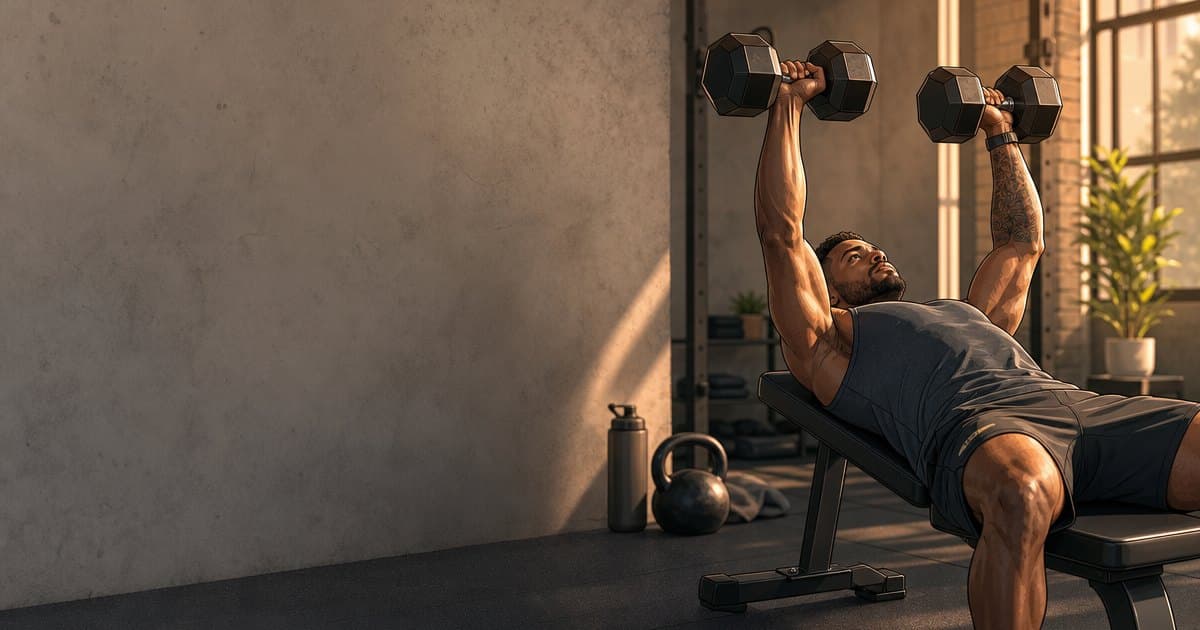
Are dumbbells enough to build muscle?
The short answer: yes, and it's not close. Muscle grows in response to hard, progressively heavier work taken near failure — the tissue doesn't know what's loading it. Dumbbells cover every pattern growth depends on: horizontal and vertical pressing, rows, squats, hinges, and isolation for arms and shoulders. They also bring two advantages a barbell doesn't: each arm works independently (so a stronger side can't quietly carry a weaker one), and joints move through freer paths, which most people's shoulders appreciate on presses.
What actually stalls home lifters is almost never the equipment. It's structure — training without a plan that forces more work over time. A rotation of random YouTube sessions keeps you sweaty and stationary. The fix is the same one that works in a commercial gym: a fixed split, fixed lifts, and numbers you're trying to beat.
The three rules that matter at home
- Progressive overload, tracked. Add reps first, then weight. When you hit the top of a rep range on every set, move up ~5 lb and build the reps back. Without a log this silently stops happening — which is why the runner logs every set for you.
- Effort close to failure. Sets of 8–15 grow muscle just as well as heavy fives if they end 1–3 reps from failure. The last two reps should be genuinely slow. This is the rule most home training quietly breaks.
- Each muscle twice a week. An upper/lower split hits everything with two quality sessions weekly and keeps recovery honest — two days on, one day off, repeat.
The 4-day plan
RepDriver's free Dumbbell Mass Builder is a four-day upper/lower split on a 2-on/1-off rhythm — the sustainable complement to our 6-day Arnold split for people with real schedules. Every session is guided by the timed runner: work and rest timers, per-set weights auto-scaled to your dumbbells, warm-ups included.
| Day | Focus | Anchor lifts |
|---|---|---|
| Upper Power A | Press-led upper body | Dumbbell bench press, one-arm row, shoulder press |
| Lower Power A | Squat-led lower body | Goblet squat, Romanian deadlift, split squat |
| — rest — | ||
| Upper Power B | Pull-led upper body | Two-dumbbell row, incline press, lateral raises |
| Lower Power B | Hinge-led lower body | Dumbbell deadlift, lunges, good mornings |
Follow it in the app
Dumbbell Mass Builder — 4-day upper/lower split
Eight weeks of guided hypertrophy with dumbbells and a bench. Sets, reps, rests, and weights all handled by the runner — try any day free, no signup.
Try any day free — no signupThe moves that matter
Six lifts do most of the growing. Tap any one for the step-by-step form page.
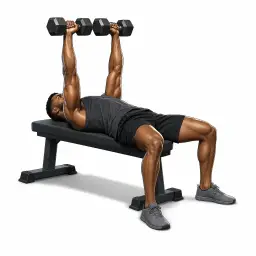
Dumbbell Bench Press
The horizontal-push anchor — deeper stretch than a barbell allows.
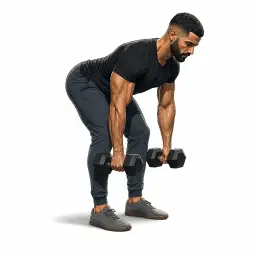
Two-Dumbbell Bent-Over Row
The pull that balances all that pressing. Flat back, elbows driving behind you.
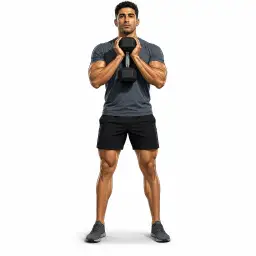
Goblet Squat
The most coachable squat there is — the weight itself keeps you upright.
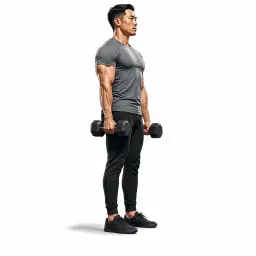
Dumbbell Romanian Deadlift
Hamstrings and glutes under a long stretch — the growth pattern most home plans skip.
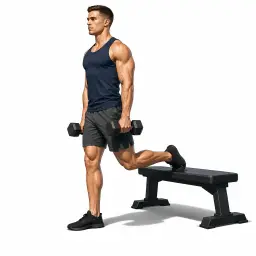
Bulgarian Split Squat
Brutal and effective — single-leg work that makes moderate dumbbells feel heavy.
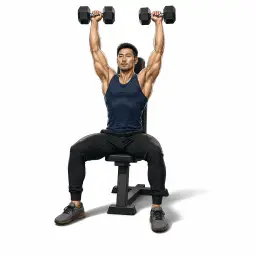
Dumbbell Shoulder Press
The vertical push, with a friendlier path for the shoulders than a bar.
Progressing when you can't add weight
Home dumbbell sets have a ceiling, and lower-body lifts find it first. When the next jump is too big or you're out of plates, overload through other doors — in this order:
- Add reps — take 3×10 to 3×15 before touching the weight.
- Slow the lowering phase — a 3-second descent makes 40 lb feel like 55.
- Shrink the rest — same work in less time is more work.
- Go single-limb — split squats and one-arm work nearly double the effective load.
- Add a pause — two seconds at the stretch removes every shortcut.
And every 6–8 weeks of hard training, take an easy week — that's when the muscle you've stimulated actually gets built. The deload guide covers exactly how, and pairs with a ready-made Deload Week routine.
Common questions
- Can you really build muscle with only dumbbells?
- Yes. Muscle grows in response to progressively harder work near failure — it doesn't care whether the load is a barbell, a machine, or a dumbbell. Dumbbells cover every fundamental pattern (push, pull, squat, hinge, carry), and their independent-arm loading even fixes some imbalances machines hide. The practical limits show up only at advanced strength levels, where a home dumbbell set may run out of weight for lower-body lifts — and slower tempos, single-leg variations, and higher reps push that ceiling far out.
- How heavy should my dumbbells be to build muscle?
- Adjustables that reach at least 50 lb (about 25 kg) per hand cover most people for years; the plan's heaviest prescription is a 90 lb dumbbell deadlift split across two hands. More important than the ceiling is granularity — being able to move up in roughly 5 lb steps is what makes week-to-week progression possible. RepDriver also auto-scales every prescribed weight to the max you enter, so the program meets whatever set you own.
- How many days a week should I lift for muscle growth?
- Three to five. The research consistently shows per-muscle volume and effort matter more than frequency for its own sake, but hitting each muscle roughly twice a week beats once. A 4-day upper/lower split is the sweet spot for most people: every muscle twice weekly, a built-in rest day every third day, and sessions that stay under an hour.
- How long until I see muscle growth?
- Strength moves first — expect noticeable rep and load increases inside 2–4 weeks, which is largely your nervous system learning the movements. Visible muscle change typically shows around 8–12 weeks of consistent training with adequate protein and sleep. That's exactly why the plan runs in 8-week cycles: long enough for real change, short enough to stay honest.
- Should I train to failure with dumbbells?
- Get close, don't live there. Most working sets should end 1–3 reps shy of failure — hard enough to grow, controlled enough to recover and to keep form honest. The last set of an exercise can push closer. Dumbbells are actually forgiving here: no bar to get pinned under, so pushing near failure on presses is safer than with a barbell and no spotter.
- Do I need a bench?
- It helps a lot — flat and incline pressing, rows, and split squats all use one, and the plan assumes it. A cheap adjustable bench is the single best accessory purchase for a dumbbell home gym. Without one, floor presses and elevated-foot variations substitute, but the bench earns its space quickly.
Sources & further reading
The claims in this guide are backed by peer-reviewed research and public-health and professional bodies. Follow any link to read the primary source.
- 1.Free weights and machines produce equal muscle growth — BMC Sports Science, Medicine & Rehabilitation (2023), meta-analysis
- 2.Training each muscle about twice a week beats once for growth — Sports Medicine (2016), meta-analysis
- 3.Early strength gains come largely from the nervous system, before visible muscle — Journal of Physiology (2019)
- 4.Lighter sets taken close to failure build as much muscle as heavy ones — J. Strength & Conditioning Research (2017), meta-analysis
- 5.About 1.6 g of protein per kg of bodyweight maximizes training gains — British Journal of Sports Medicine (2018), meta-analysis
Put it on your real calendar.
Create a free account to schedule the routine, follow along with voice guidance and music, and log every session — or just browse the library first.
Create a free account