
The Arnold Split, with Dumbbells
Arnold's classic chest-and-back, shoulders-and-arms, legs rotation hits every muscle twice a week — and it maps onto a pair of adjustable dumbbells almost perfectly. Here's how to run it without a barbell.
8 min read · Updated July 2026

What the Arnold split actually is
The Arnold split is the routine Arnold Schwarzenegger built his physique on, and its logic is simple: three training pairings — chest and back, shoulders and arms, and legs — rotated so that across a week, every muscle group gets trained twice. Six training days, one rest day, a lot of volume.
The signature is the chest-and-back pairing. Instead of blitzing chest to exhaustion and then starting back, you alternate between them — a press for the chest, a row or pullover for the back — so while one muscle works, its opposite recovers. You keep moving, the session stays dense, and both muscles get a full share of hard work. Shoulders-and-arms follows the same antagonist logic (press against pull, biceps against triceps); legs get their own day.
Why training each muscle twice a week works
The split's real engine isn't the antagonist supersets — it's frequency. When you match the total number of hard sets, training a muscle about twice a week tends to beat training it once. Splitting your weekly chest work across two sessions instead of one cramming session means each session is fresher, higher quality, and followed by another growth signal a few days later while the first is still fading.
That's the whole reason the Arnold rotation exists: it's a structure that forces twice-a-week frequency without you having to think about it. Chest gets hit on the chest-and-back days; shoulders and arms get their dedicated day plus the indirect work from all that pressing. The volume adds up fast — which is exactly why recovery, not effort, is the thing that limits it.
Why dumbbells fit the Arnold split so well
Most Arnold-split guides assume a barbell and a full commercial gym. You don't need either. The pairings are built from presses, rows, flyes, curls, extensions, raises, and squats — every one of which has a clean dumbbell version, and several of which are better with dumbbells:
- Presses gain range of motion. Dumbbells let your hands travel deeper at the bottom and closer together at the top than a bar allows. Change the bench angle and you shift the emphasis up or down the chest — flat for the mid and lower chest, a ~30° incline for the upper.
- Each side works on its own. A strong side can't carry a weak one, so the left-right imbalances a barbell hides get evened out over time.
- Your joints pick the path. Wrists and shoulders rotate freely instead of being locked to a fixed bar, which most people find kinder on cranky shoulders.
- The signature Arnold moves are dumbbell moves. The Arnold press, the incline dumbbell press, the flye, and the pullover — the exercises the split is famous for — were built around dumbbells in the first place.
You give up the very top-end loading of a heavy barbell, but for building muscle that matters far less than most people assume — a longer range of motion and clean, hard sets do the job.
How to actually progress
High frequency only pays off if the sessions are hard and recoverable. Two rules keep that balance:
- Stop a rep or two short of failure. Grinding every set to absolute failure multiplies fatigue without a matching payoff — stopping one to three reps shy builds essentially the same muscle and leaves you able to do it again in two days. On a six-day split, that recoverability is the whole game.
- Use double progression. Pick a rep range — say 10–12. Add reps each week until you hit the top of the range on every set; then bump the dumbbells up and drop back to the bottom of the range. Adjustable dumbbells make those small increases painless.
Expect the first few weeks to feel like the weights jump quickly — early gains come largely from your nervous system learning the movements before visible muscle catches up. Keep the reps honest and the progression steady.
| Day | Pairing | Sample dumbbell work |
|---|---|---|
| 1 | Chest & Back | Incline press · flye · one-arm row · pullover |
| 2 | Shoulders & Arms | Arnold press · lateral raise · curl · overhead extension |
| 3 | Legs | Goblet squat · Bulgarian split squat · RDL · calf raise |
| 4–6 | Repeat 1–3 | Same pairings, second pass of the week |
| 7 | Rest | Recover — this is where the muscle gets built |
The ready-made plan
RepDriver's free Arnold Split (Dumbbell Edition) packages the whole rotation so you don't have to assemble it: the three pairings, dumbbell-only, with a sustainable rest cadence built in and weights that auto-scale to your own max once you sign in. The cadence itself is yours to change, too — once you're subscribed, the schedule setting lets you run the rotation two-on-one-off, three-on-one-off, or whatever your recovery actually supports, and the calendar reshuffles around it. Each session runs in the guided timer with form cues, so you can just follow along.
Follow it in the app
Arnold Split (Dumbbell Edition)
The classic chest-and-back, shoulders-and-arms, legs rotation — dumbbell-only, twice-a-week frequency, guided. Try it free, no signup.
Try the Arnold split freeThe moves the split is built on:
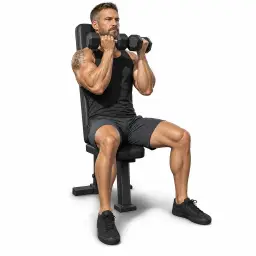
Arnold Press
The namesake — rotate from palms-in at the bottom to palms-forward overhead for full delt sweep.
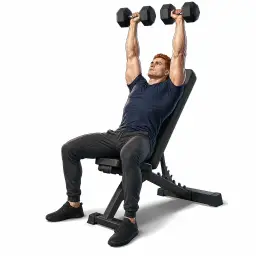
Incline Dumbbell Press
~30° bench to bias the upper chest; dumbbells sink deeper than a bar.
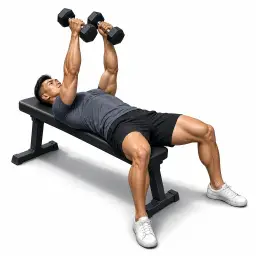
Dumbbell Flye
A long stretch across the chest a pressing bar can't match.
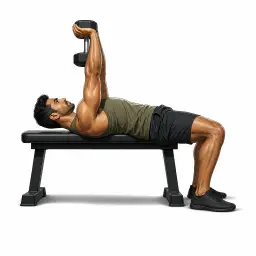
Dumbbell Pullover
Arnold's favorite — hits back and chest through a huge arc.
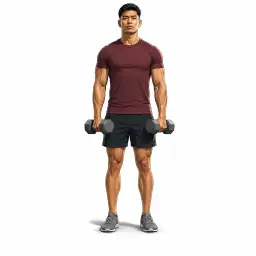
Lateral Raise
Lead with the elbows, thumbs slightly forward, to load the side delt.
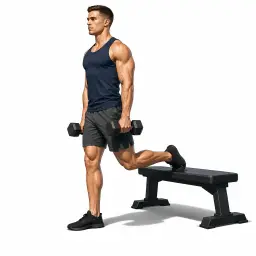
Bulgarian Split Squat
The dumbbell answer to heavy barbell leg work — one leg at a time.
The mistakes that stall it
- Running it too soon. The Arnold split rewards intermediates. As a first routine it's six days of volume you can't yet recover from — you'll spin your wheels. Build a base on full-body training first.
- Training every set to failure. On a six-day plan that's a fatigue spiral. Leave a rep or two in the tank and you can bring real quality to the next session.
- Skipping the rest day. The muscle is built between sessions, not during them. Seven-days-a-week isn't dedication, it's sabotage.
- Never adding weight. Frequency without progression is just cardio with dumbbells. Track your reps and push the loads up when the top of the range gets easy.
- Chasing the exact six-day layout at the cost of consistency. Three real sessions a week beat six you keep bailing on. Run the rotation on a cadence you'll actually hold.
Common questions
- What is the Arnold split?
- It's the training split Arnold Schwarzenegger built his physique on: three pairings — chest and back together, shoulders and arms together, and legs — rotated across six training days so each muscle group gets trained twice a week. The chest-and-back pairing is the signature move, letting you superset a press against a row so one muscle rests while its opposite works. It's a high-volume, high-frequency approach best suited to intermediates who can recover from six sessions a week.
- Can you really do the Arnold split with just dumbbells?
- Yes — arguably better than most splits translate to dumbbells. The pairings are built from presses, rows, flyes, curls, extensions, raises, and squats/lunges, all of which have clean dumbbell versions. You lose the very heaviest barbell loading, but you gain a longer range of motion on presses and flyes, independent left-right work that evens out imbalances, and joint angles your wrists and shoulders choose for themselves. A pair of adjustable dumbbells covers the whole rotation.
- How many days a week is the Arnold split?
- The classic version is six training days with one rest day, hitting each muscle group twice. If six days is too much to recover from — and for most people with jobs and families, it is — you can run it as a three-day rotation (chest/back, shoulders/arms, legs) and simply cycle through it every other day, which still lands each muscle roughly twice across an eight-day span. RepDriver's version is built around a sustainable cadence rather than forcing six straight days — and the rest cadence is adjustable on your subscription, so you can run it two-on-one-off, three-on-one-off, or whatever fits your recovery.
- Is the Arnold split good for building muscle?
- For an intermediate lifter who can recover from the volume, yes. Its core strength is frequency: training each muscle about twice a week tends to beat once-a-week splits when the total number of sets is matched, and the Arnold split bakes that frequency in. The catch is the recovery demand — beginners generally grow just as well on a simpler full-body plan with far less time in the gym, and should start there.
- How heavy should the dumbbells be?
- Heavy enough that the last couple of reps of a set are genuinely hard, but light enough that you stop one to three reps short of failure on most sets — that's where the muscle-building return sits without the recovery cost of grinding to failure every set. In practice that means picking a weight you could do maybe 12–15 reps with and stopping around 10–12. When that becomes easy, add weight. Adjustable dumbbells make those small jumps painless.
- Who should not run the Arnold split?
- Beginners in their first several months of lifting, anyone who can only train two or three days a week, and anyone coming back from a layoff. The split's whole premise is high frequency and high volume — if you can't consistently recover from six sessions, you'll accumulate fatigue faster than you build muscle. A full-body or upper/lower plan delivers most of the benefit with far more forgiveness. Come to the Arnold split once training six days is realistic.
Sources & further reading
The claims in this guide are backed by peer-reviewed research and public-health and professional bodies. Follow any link to read the primary source.
- 1.Training each muscle ~2×/week beats 1× when weekly volume is equated — Schoenfeld, Ogborn & Krieger, Sports Medicine (2016), meta-analysis
- 2.Stopping 1–3 reps short of failure carries no significant hypertrophy penalty — Grgic et al., failure vs non-failure meta-analysis
- 3.Pec activation shifts with press angle (flat = mid/lower, incline ~30° = upper chest) — Int. J. Environmental Research & Public Health (2020)
- 4.Side-delt recruitment peaks with a neutral, thumbs-forward hand position on lateral raises — Int. J. Environmental Research & Public Health (2020)
- 5.Early strength gains come largely from the nervous system before visible muscle — Del Vecchio et al., Journal of Physiology (2019)
Put it on your real calendar.
Create a free account to schedule the routine, follow along with voice guidance and music, and log every session — or just browse the library first.
Create a free account